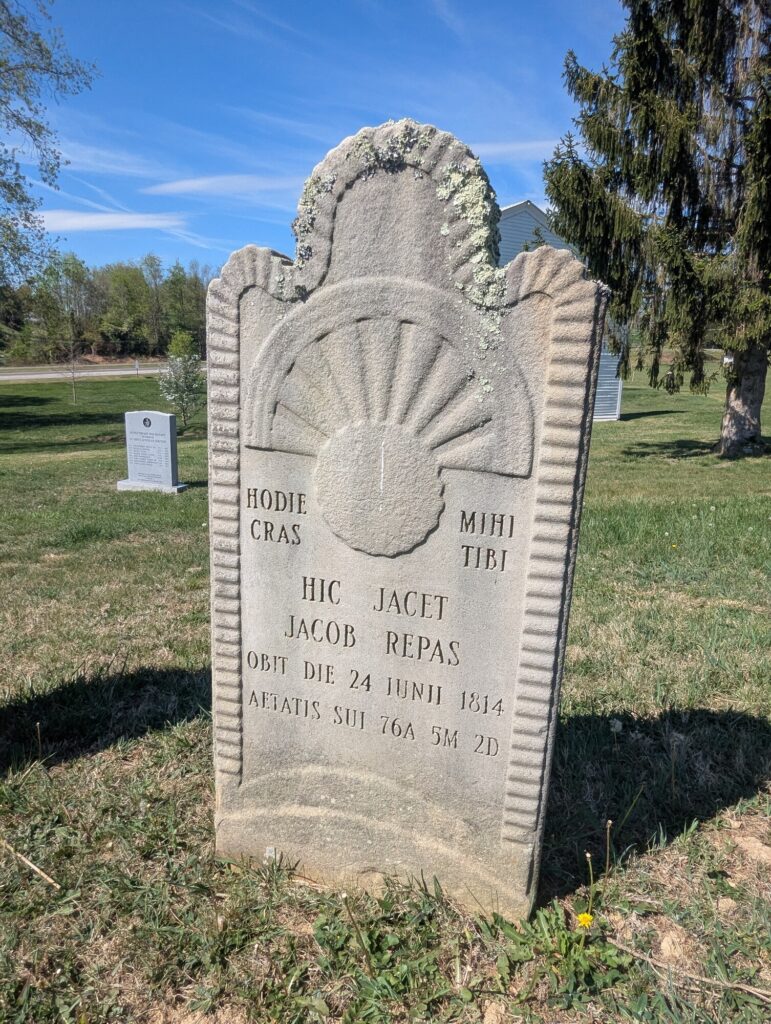
Laurence Krone (d. 1836) was the only early western Virginia German stone carver known by name, and one of the most accomplished carvers in Virginia history. His work at St. John’s Lutheran Church represents one of the finest collections of early German funerary art in the commonwealth.
The Carver
Little is known about Laurence Krone’s origins. He appeared in Wythe County sometime before 1815, the year he first bought land there. He signed his monuments “LAURENCE KRONE STON MASON.” Besides being the only early western Virginia carver known by name, Krone was noteworthy for his unusual coffin-shaped tombs, for the skill with which he lettered his monuments, for being one of the few carvers to use German inscriptions, and for the generally superior quality of his designs and their execution.
His Work at St. John’s
The cemetery at St. John’s contains approximately thirty early nineteenth-century, German-style monuments carved by Krone, dating from 1812 to 1826. These stones display a variety of striking decorations: the usual complement of lilies and roses, stylized sunbursts, and the moon surrounded by seven stars.
The Flohr Monument
One of the principal works in Krone’s oeuvre is the tomb he carved for Georg Flohr (d. 1826), St. John’s first pastor, “at his private cost.” It is a three-part monument consisting of a headstone, an unusually large footstone, and a coffin-shaped slab with a central ridge. All are characteristic products of Krone’s art.
The headstone has rounded shoulders and a central three-quarter-round element with a stylized rose in it. It is lettered in Latin:
IN MEMORIAM / REVERENDI / GEORGII D. FLOHR / OBIIT XXX DEI APRILIS / ANNO DOMINI MDCCCxxvi / NATUS ANNOS. LXIII. / MENSES VIII.
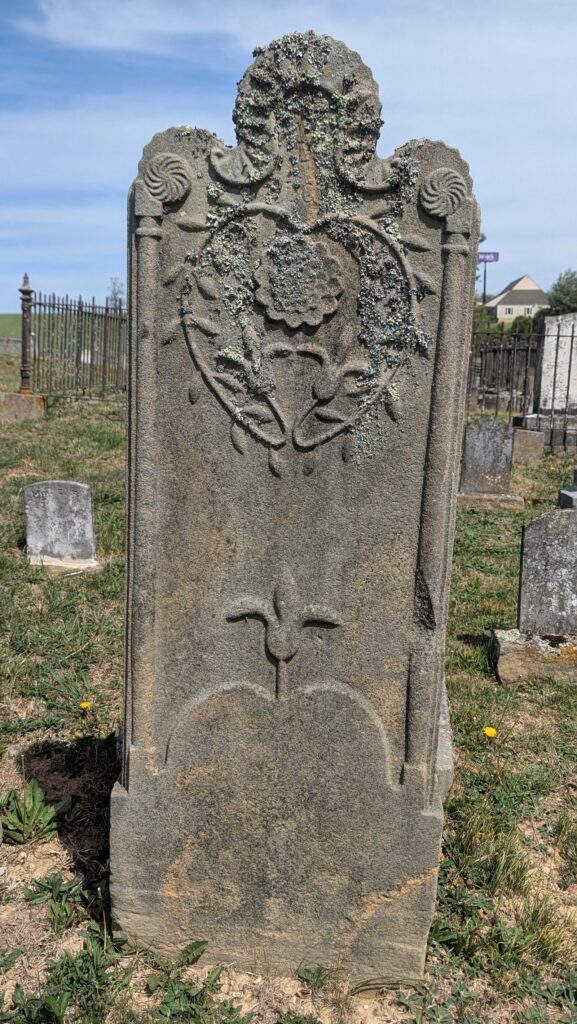
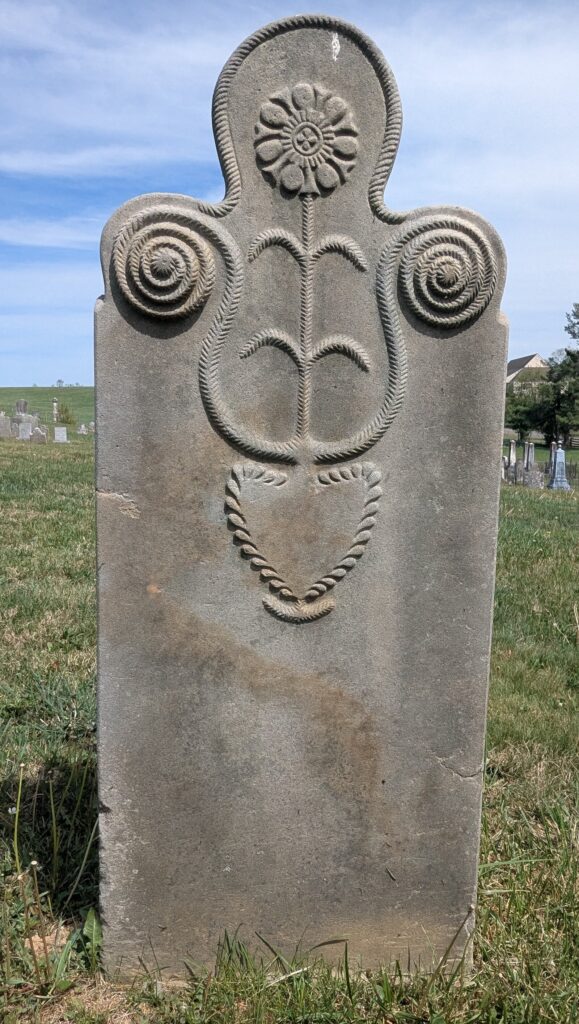
A short Latin epitaph is followed by an English translation of the vital data. The front and edges of the thick stone have a serrated “pie-crust” decoration typical of Krone’s work, and the reverse of the stone — usually decorated in German practice — has one of Krone’s favorite motifs: a heart formed by the stems and blooms of lilies with attenuated colonettes flanking it.
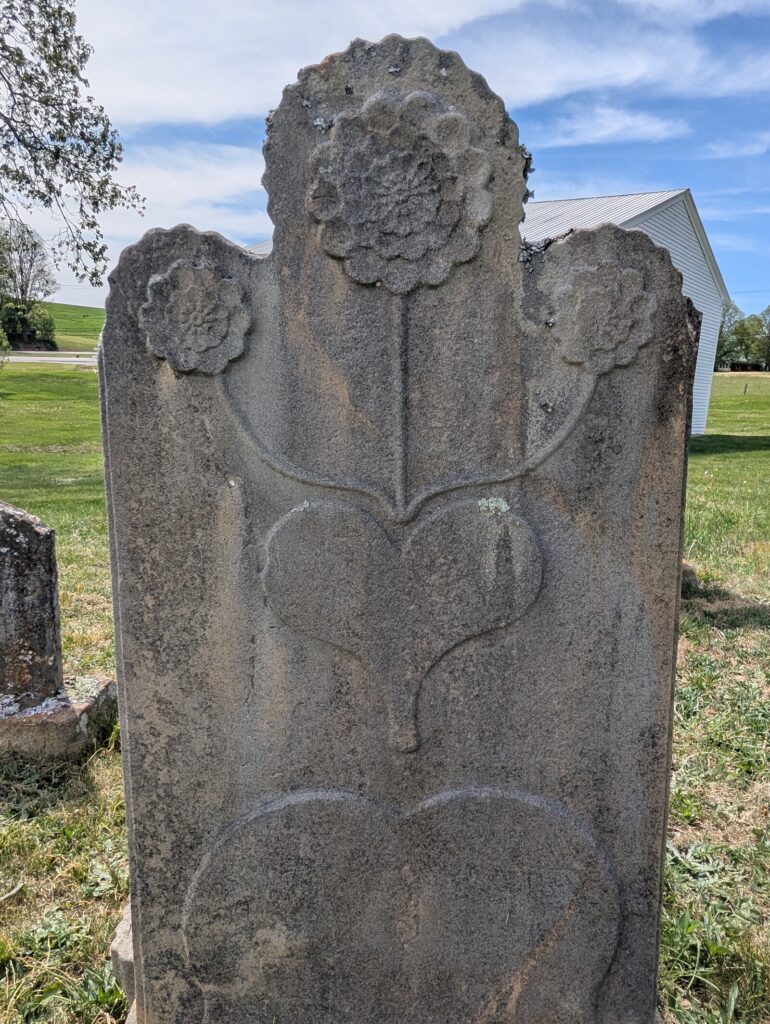
The coffin and the footstone also have serrated edges. The footstone has a long epitaph in German inscribed with Gothic lettering. The reverse of the footstone is embellished with another favored Krone design — three roses springing from a heart.
Other Works
Krone’s stylistic elements allow the near-certain attribution to him of stones at the Fort Chiswell cemetery in Wythe County and other scattered works throughout the region. He is also documented as having made the gates and wall and two table tombs for the Cloyd family burying ground at Back Creek Farm in Pulaski County. A similar family memorial, the Denton monument in Roanoke County, is signed with his name and demonstrates that he was the creator, and not merely the donor, of Flohr’s tomb.
The Sunflower Motif
Among Krone’s most distinctive carvings are the tall, stylized sunflowers that rise from the heart-and-stem motifs on several footstones — visible at the top of this page. The design combines two of his favored elements: the Germanic heart-with-stems and a full-face flower rendered with deeply cut petals that still catch the light cleanly two centuries on. On the Flohr monument, the coffin-shaped footstone carries this motif on its reverse — characteristic of Krone’s habit of decorating the stone’s back as well as its front, in keeping with German funerary practice.
The Memorial Plaque
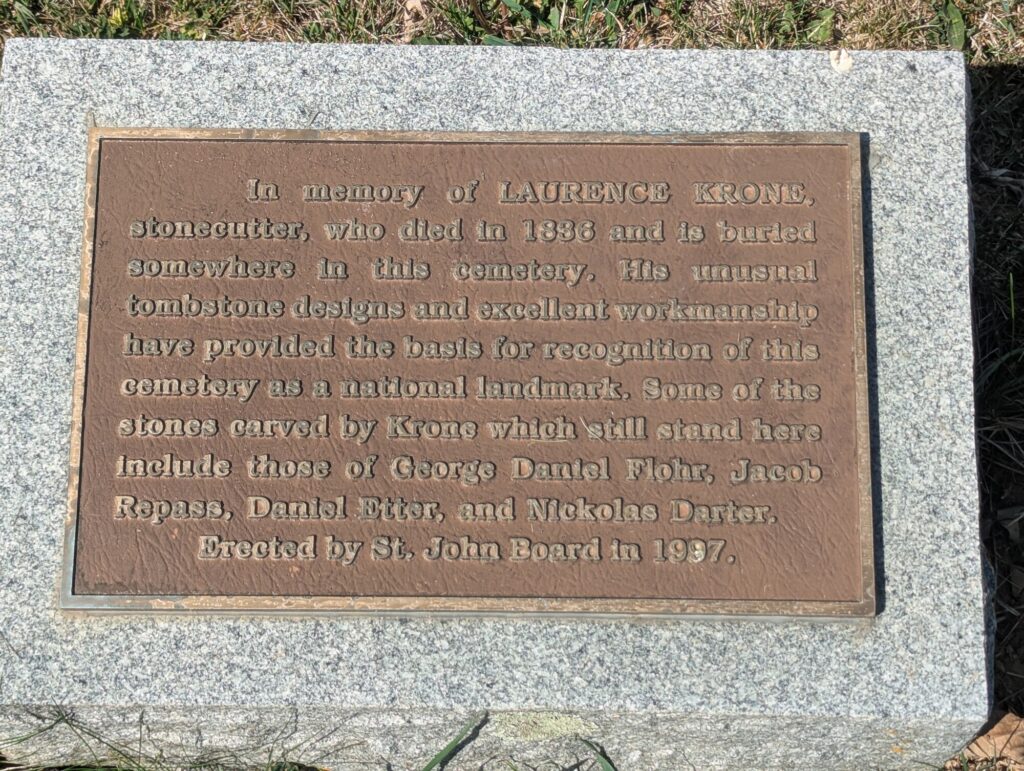
A bronze plaque on the cemetery grounds, erected by the congregation in 1987, honors Krone’s legacy. It reads:
In memory of LAURENCE KRONE, stonecutter, who died in 1836 and is buried somewhere in this cemetery. His unusual tombstone designs and excellent workmanship have provided the basis for recognition of this cemetery as a national landmark. Some of the stones carved by Krone which still stand here include those of George Daniel Flohr, Jacob Repass, Daniel Etter, and Nickolas Darter.
Erected by St. John Board in 1987.
Krone-Signed Stones at St. John’s
The plaque names four congregants whose stones are Krone’s work. Each record links to its cemetery entry:
- Rev. Georg D. Flohr (d. 1826) — founding pastor; three-part monument with sunflower footstone.
- Jacob Repass (1737–1814) — pictured above; the best-preserved Krone headstone at St. John’s.
- Daniel Etter (1752–1805) — early Wythe County settler; stone carved some years after his death.
- Nickolas Darter (1746–1821) — congregant from the earliest decade of the church.
An estimated thirty Krone stones stand at St. John’s. Browse burials from 1812–1826 to find more of his work, or use the full cemetery search.
Source: National Register of Historic Places Inventory — Nomination Form, St. John’s Lutheran Church and Cemetery, Wythe County, Virginia. Prepared by Virginia Historic Landmarks Commission, April 1977.
For a scholarly treatment of Krone’s work in the context of Wythe County’s German artisan community, see Slough, Spenser David, Germans on the Western Waters: Artisans, Material Culture, and Hybridity in Virginia’s Backcountry, 1780–1830 (M.A. thesis, Virginia Tech, 2015); and Klutz, Roger S., Beside the Still Waters: The Story of the German Settlements and the Lutheran Church in Wythe County, Virginia (Blacksburg, VA: Privately Published for the Author, 1999).